

Key Takeaways
-
Fasting is a popular strategy for fat loss and for increasing discipline, carrying with it myriad benefits including reduced inflammation and enhanced mental clarity.
-
Without proper consumption of calories, proteins and amino acids, muscle loss will occur during periods of fasting.
-
Fasted training is exercise without food consumed in the last eight to 12 hours, which can lead to more fat burned during the workout.
-
While consumption of Essential Amino Acids technically will break a fast, they are necessary to keep muscle synthesis activated when no food is present to stimulate lean mass growth and recovery.
-
Enhance gains with Oh!mino® Muscle Synthesis Activator and Creatine Complex, delivering all nine essential amino acids, including BCAAs, electrolytes, and adaptogens to accelerate muscle growth, recovery, and performance.
The Faster's Guide to Muscle Preservation: Why Oh!mino is Your Secret Weapon
Many athletes prefer various forms of fasting integrated into their daily routines. This may be for mental discipline or body recomposition goals, or because one can become too busy to eat! The two most prominent versions of fasting for the athlete is cutting and intermittent fasting. While cutting is not technically a fast, it is a withholding of certain quantities of food in order to achieve a physical reaction. Fasting has received hundreds of studies, some citing its efficacy and others, its drawbacks. How can the athlete mitigate the negative effects of fasting while still reaping its benefits?
|
Oh!mino©: Elevate Your Performance. Accelerate Your Recovery. Science-Backed Superiority for Every Fitness Journey Power Your Goals with Proven Results:
The Oh!mino® Advantage: ✓ Patented formula that’s 11x more effective than protein, 20x more effective than BCAAs Choose Your Perfect Formula: Available in refreshing Tropical Slash or Berry Blast flavors, with stimulant-free or caffeinated options. Prefer capsules? We've got you covered with the same powerful formula. Take before, during, or after training—one solution for your entire workout. |

Fasting and Cutting
While this blog centers more on fasting and intermittent fasting, cutting is included as well for its similar processes and results. Fasting is cutting out food entirely. Some may fast for one day or multiple, relying only on water, coffee and other calorie-free drinks. Intermittent fasting is choosing to eat one’s meals within certain hours of each day, leaving the other hours food-free. Similarly, cutting is reducing (but not excluding entirely) food intake during each meal.
Benefits of Fasting
There have been many studies observing the benefits of fasting. Some of these recorded benefits include improved insulin sensitivity, more fat burned for fuel, reduced inflammation and enhanced cognitive clarity. The body reacts positively in many cases to a controlled fast, especially for those who are early in their fitness journey and looking to remove unneeded fat.
Benefits of Cutting
For the experienced athlete, alternating phases of bulking and cutting may be the norm, and for good reason. Muscle building is expedited when the body has excess calories with which to repair worn muscle tissue. However, with these excess calories come unnecessary fat. Cutting will remove the fat stored during the bulking phase, leaving the athlete with his true physique visible. This process also encourages a sharp mind and practiced discipline, as extra food can be extremely tempting when one is hungry each day.
Benefits of Intermittent Fasting
Intermittent fasting is the process of only eating food during certain hours of the day. With this process comes improved fat loss, cellular repair and appetite regulation, and can improve blood pressure and triglycerides. This style of eating also produces mental toughness by rejecting the body’s desires and only choosing to eat when the time is appropriate.
Intermittent Fasting
Intermittent fasting has gained in popularity in recent years as many individuals seek a quick and simple way to lose fat. The only way to lose fat is to eat less and move more; intermittent fasting can act as guardrails for one attempting to eat less and move more. However, with intermittent fasting comes some risks. How can these risks be navigated?
Popularity
Everyone who wishes to get into fitness and lose weight wants to do so quickly–that is only human nature. This drive has led intermittent fasting to be a forerunner in managing this endeavor. However, many may make the mistake of believing that it does not matter what one eats during his approved eating periods. The given eating periods (usually organized as 8 hours of acceptable eating with 16 hours of fasting) must still include whole, protein-rich foods. Eating junk food during these hours will not result in any meaningful change.
Risks
With the benefits of intermittent fasting comes many potential risks. For active individuals, intermittent fasting can result in unwanted muscle loss and reduced training performance. It can also disrupt one’s hormonal patterns and sleep schedule. Individuals with an unhealthy relationship with food may have their symptoms exacerbated by this rigid schedule.
Integrating EAAs
Due to the imminent risk of muscle loss during periods of fasting, EAA supplementation may be of great value. Taking EAAs prior to and after one’s fasting period will enable one’s muscle mass to have what it needs for repair and growth even while no food is being supplied. While EAAs technically will break a fast, the calories present in an EAA blend (such as our Muscle Synthesis Activator) do not act the same as normal, consumed calories. The EAAs will bypass digestion and head to lean tissue, therefore preserving and improving muscle mass.

Man looking at forearm at a restaurant.
Fasted Training
As part of a fasting-focused day, one’s workout may occur during a period of no food intake. One will train fasted if no food has been consumed for eight to 12 hours prior to exercise. There have been many studies observing the risks and rewards of fasted training, whether it is better for the body or whether it is ultimately counterproductive. Regardless of one’s choice to workout on an empty stomach or after a hearty snack, integrating EAAs into one’s routine will support any and every athletic endeavor.
Benefits
Many benefits have been touted for fasted training. Some of these include letting the body burn more fat as fuel, improving mitochondrial efficiency during endurance workouts and lessening perceived gut discomfort when working out. These benefits are most readily reaped when performing low-intensity cardio, allowing the body to burn fat more efficiently. Many athletes simply enjoy how their body feels without food in it when working out, and if that works for some, then continue in that practice.
Risks
With less food in the body comes less glycogen availability, leading to a lessened strength output and reduced endurance. Unless daily protein intake is consistently high, muscle breakdown may be exacerbated. Additionally, fasted training can raise one’s cortisol levels (stress levels). If no food is consumed post-workout, muscle recovery will be hindered and energy will be low for future training sessions.
Integrating EAAs
EAAs will not solve all of the drawbacks that may come with fasted training. However, it can aid in reducing the potential for lean tissue breakdown, if supplemented before, during and after training. If consumed, EAAs technically break a fast, but muscle mass will be supported without having to consume any foods within that window.
Essential Amino Acids and Muscle Breakdown
As stated above, Essential Amino Acids directly benefit muscle mass, whether one trains fasted or after a full meal. EAAs play a significant role in the body by stimulating muscle synthesis. Many athletes choose to ignore EAA supplementation in favor of diet, which can have its own set of drawbacks.
The Role of EAAs
The body cannot produce Essential Amino Acids on its own. EAAs must be consumed in some form in order for the body to utilize these necessary molecules. EAAs are found in some foods and can be consumed as a supplement. EAAs, once in the body, head to lean tissue that must be repaired, hence beginning the process of muscle synthesis.
The Process of Muscle Synthesis
Muscle synthesis is the process of lean tissue repairing and growing after being worn and broken down from exercise and activity. The athlete's muscles will constantly need reinforcing and growth due to the demands placed on the muscle mass during each workout. The body uses EAAs to fix the microtears in one’s muscle, rebuilding lean tissue stronger and denser. This recovery process is essential for the athlete who desires to recover quickly and efficiently.
Diet vs. Supplementation
Some athletes prefer to skip supplementation and opt instead to rely solely on EAAs consumed from food. Meat, fish and dairy all contain EAAs (being the reason why consuming a high-protein diet is essential for the athlete). However, these EAAs do not come in optimal ratios and must pass first through one’s digestive track before making it to tired lean tissue. EAAs consumed via supplementation will be in a blend optimized for ideal muscle growth and will head straight to lean tissue, quickening recovery.

Woman looking at watch.
Muscle Synthesis During Fasting
The process of muscle synthesis can become tricky to navigate if on a consistent fasting routine. Potential muscle breakdown is always a threat, leading many to wonder if it is possible to grow muscle during fasting. A routine of fasting comes with many benefits, however, are the drawbacks too significant to be worth the effort?
Potential Muscle Loss
Without enough food, muscle will break down during rest, and if fasted training is included, will break down significantly during training. The body will not have enough calories or amino acids to efficiently synthesize new muscle. Eating enough food around one’s fasting window will help to minimize this result, however, only with supplementing with EAAs can muscle loss be properly mitigated during a fast.
Can Muscle Grow During Fasting?
Muscle can grow during the day only if enough calories and protein is consumed within one’s blocks of eating. A proper diet must still be managed when one fasts; taking in excessive amounts of food during a feeding window will result in fat gain. However, not eating enough will encourage muscle loss when food is absent. By supplementing EAAs alongside balanced meals, the body will have enough amino acids to synthesize muscle during mealtimes, thereby compensating for any muscle loss while fasting.
Drawbacks of Fasting
The risk of inadequate protein and calorie consumption in a fasting routine is real. Conversely, overconsumption in an effort to make up for hungry hours can also occur. The many benefits of fasting will be negligible if daily dietary intake is insufficient or gluttonous. However, if caloric goals are met and one’s fasting plan is able to be adhered to, many good results can come from this age-old discipline.
Choose What Is Right For You
Fasted training and intermittent fasting come with a host of positive effects and beneficial outcomes. However, if done incorrectly, muscle mass can be lost and fatigue will increase. Some find satisfaction in a strict fasting routine. For others, this seems impossible and unlikely to support current goals. Whether one prefers fasting or eats light on the hour, consuming adequate protein and EAAs will benefit overall performance.
Enhance Your Gains with Oh!mino® Muscle Synthesis Activator & Creatine Complex
Take your muscle-building journey to the next level with Oh!mino®’s next-generation supplements, specifically engineered to maximize strength, endurance, and recovery.
Oh!mino® Muscle Synthesis Activator
Our patented formula delivers all nine essential amino acids, including the crucial BCAAs, in an optimal ratio to fuel muscle growth while minimizing soreness. Designed for pre-, intra-, and post-workout use, it stimulates muscle protein synthesis up to 11x more than whey protein and 20x more than standalone BCAAs, helping you recover faster, reduce stiffness, and train harder.
Enhanced with adaptogens and fully balanced electrolytes, it supports endurance, hydration, and overall performance. Non-dairy, vegan, and free from sugar, carbs, calories, and artificial additives, it’s a clean, science-backed supplement trusted by athletes.

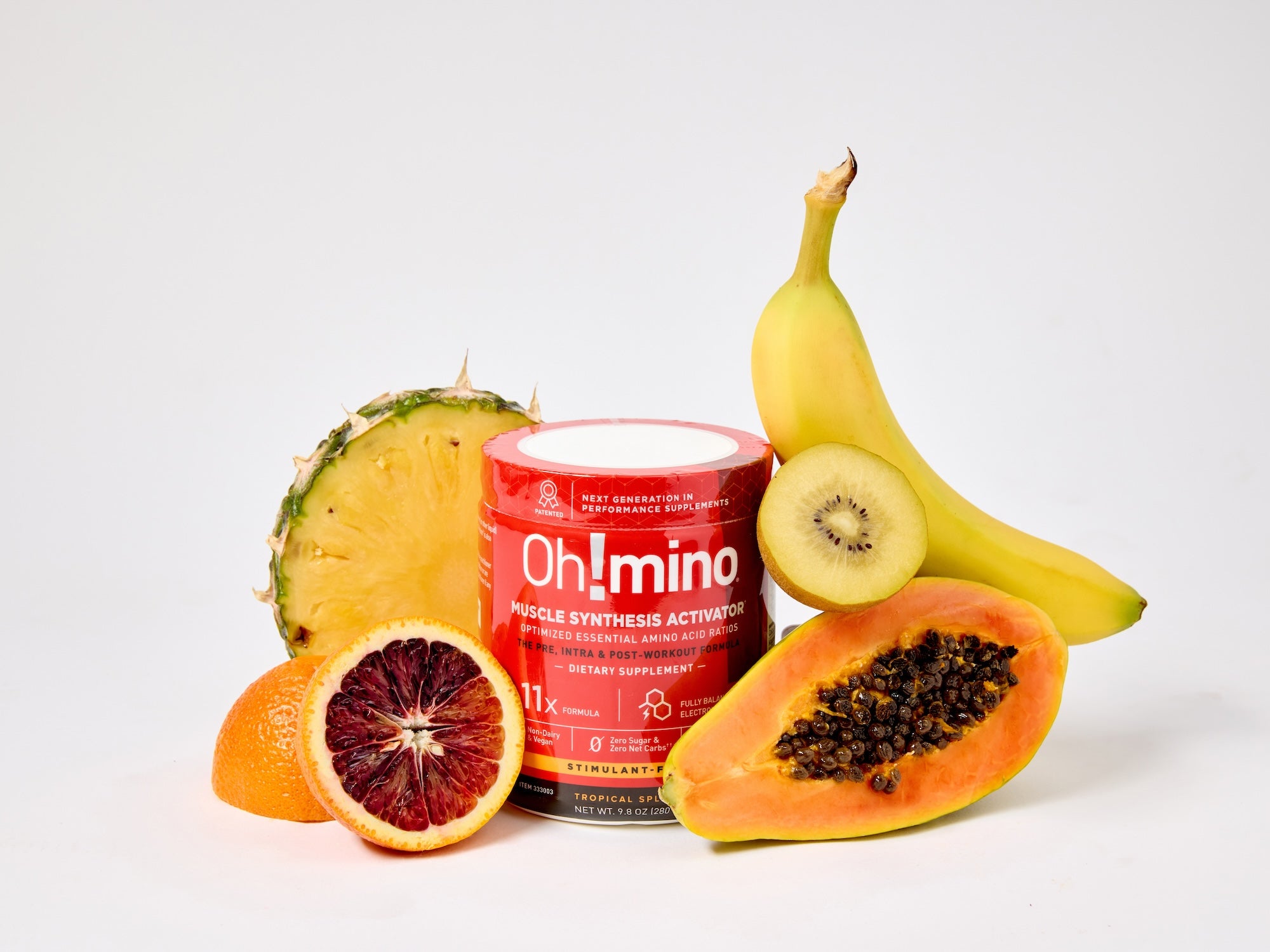
Oh!mino® Muscle Synthesis Activator supplement container.
Oh!mino® Creatine Complex
Our patented Creatine Complex combines clinically studied forms, micronized Creatine Hydrochloride and Creatine Monohydrate, with adaptogens to boost absorption by over 300%. Each scoop delivers 3 grams of free-form creatine to support muscle growth, enhance recovery, and improve training endurance.
Delicious lemon-lime flavor makes it easy to stack with our Muscle Synthesis Activator or use on its own for maximum results. Designed for pre- and post-workout consumption, it complements your training regimen while keeping your supplement routine clean, vegan, and free from unnecessary additives.
Together, Oh!mino® Muscle Synthesis Activator and Creatine Complex provide a comprehensive, science-backed approach to building lean muscle, accelerating recovery, and enhancing performance, all with a clean-label formulation that supports serious gains without compromise.

Creatine remains one of the most researched supplements for muscle volume and strength.
Start Your Transformation with Oh!mino® Today!
Frequently Asked Questions (FAQs)
Do EAAs completely prevent muscle breakdown during a fast?
No they do not. EAA consumption will mitigate muscle loss during a fast, but cannot prevent it outright. EAAs are not meant to replace protein-rich meals, but will support the nutrients and proteins consumed through food.
How many scoops of your Muscle Synthesis Activator should I take before a fast?
As many as you wish! Our product is extremely safe; one can take the recommended one to two scoops or may increase the amount of scoops if more EAAs are desired.
Are EAAs superior to whey protein for fasting?
Yes they are. Our Muscle Synthesis Activator is 11x more effective than whey protein in stimulating muscle growth. Consuming whey protein will add unnecessary calories to one’s fasting routine, while EAAs add negligible calories while being more effective for muscle synthesis.
Does fasted cardio burn more fat overall?
Improved fat burning from fasted cardio may occur primarily in low-impact activities such as walking, hiking or short jogs. More intense cardio sessions may result in increased muscle breakdown as glycogen stores are lowered.
Who should avoid fasting?
For those who have a chronic medical condition and/or are taking prescription medication, consult first with a doctor. For most healthy adults, controlled fasting and intermittent fasting can yield positive, beneficial biological and cognitive results.


